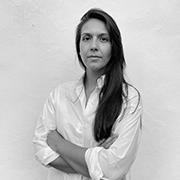
Maria Neto
Maria Neto is an architect, researcher, and lecturer whose work bridges architecture, humanitarian action, and housing policy, focusing on the spatial dimensions of displacement and the right to housing under conditions of precarity. She holds postgraduate studies in Development of Human Settlements in the Global South (ICHaB-ETSAM), professional training in Humanitarian Shelter Coordination (IFRC/UNHCR/Oxford Brookes University), and a PhD in Architecture dedicated to refugee camps in protracted situations and humanitarian governance. Her research develops a critical and transdisciplinary framework that interrogates how architecture operates simultaneously as an instrument of control and an agent of care. By combining participatory design, field research, and cartographic and photographic methodologies, she investigates the intersections between migratory movements, demographic transitions, and spatial justice, contributing new conceptual and methodological tools to housing studies, humanitarian architecture, and spatial politics. Her work is grounded in first-hand experience with humanitarian organisations such as UNHCR (Kenya/Dadaab) and the British Red Cross (UK), linking theoretical research with direct field practice in contexts of crisis and displacement. Maria Neto is the author of The Invisible Cities of Dadaab (OASRN, 2019) and Landscapes of Care (Circo de Ideias, 2022), which was selected for inclusion in the Millennium bcp Universities Anthology of the Lisbon Architecture Triennale (2022). She is also the winner of the Lisbon Architecture Triennale Universities Prize 2025 with the project The Weight of Words, affirming her leadership in using architecture as a form of political imagination. She has led and co-led research and applied projects funded by FCT, DGArtes, and Fundação “La Caixa”, including her current coordination of Landscapes of Care and Domesticity (La Caixa/FCT Promove 2025), focused on community-led housing and spatial resilience. Previously, she coordinated the UBI–FAUP–CMF cooperation project, which developed five buildings and 23 dwellings in the historical center of Fundão, funded by the National Emergency and Temporary Housing Grant (BNAUT/PRR). Recipient of multiple national and international awards, including the Fernando Távora Prize, Maria Neto represented Portugal at the 17th Venice Architecture Biennale (2021) in the debate Instant Cities, alongside Michel Agier and Manuel Herz. She has been a visiting professor at ETSAM, FAUP, ETSAC, and UVa, and is currently an Invited Assistant Professor at the University of Beira Interior (UBI). She previously collaborated with the Instituto da Habitação e da Reabilitação Urbana (IHRU), contributing to housing policy through her role at the DEPAH – Housing Support Programmes Directorate. Her research positions forced displacement as a central concern of our civilizational agenda, advocating for an expanded understanding of architecture as both a political act and a form of care. Maria Neto stands as a leading voice for an architecture conceived as an act of listening, care, and recognition, bridging theory and practice to redefine the ethical and societal role of architecture in the 21st century.